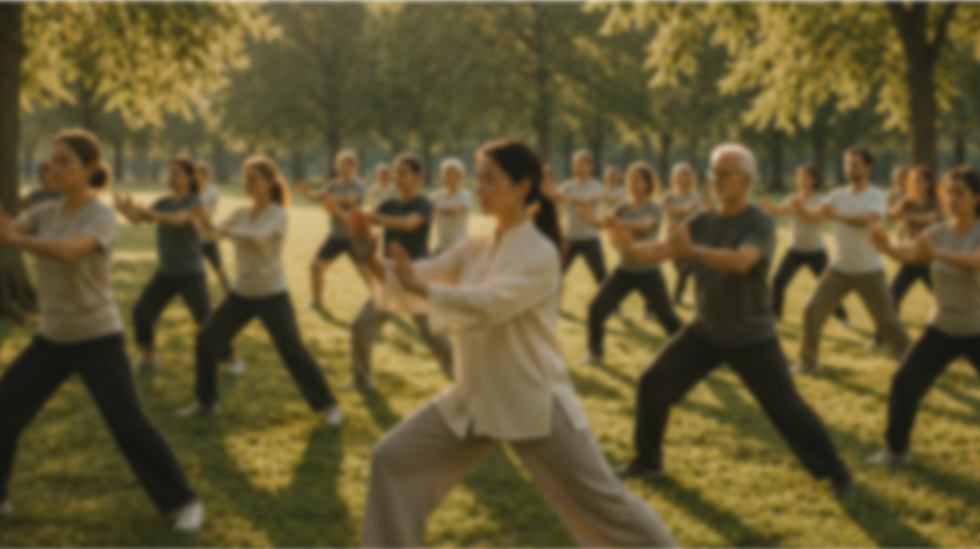

What is Qi Gong?
Qi Gong is an age-old practice, rooted at the heart of traditional Chinese medicine, aimed at prevention and cultivating good health. It brings together movement, breath and attention in a single gesture, following the meridians — those channels of energy that Chinese tradition has studied for over two thousand years. Its name says it all: Qi refers to the vital energy that flows through the body, Gong means the work, the patient mastery acquired over time. In practice, it is a series of slow, flowing exercises — standing, sometimes seated — where every movement is attuned to the breath and to inner presence.
A rooted tradition,
a recognised effectiveness
Qi Gong is one of the five branches of traditional Chinese medicine — alongside acupuncture, Tuina massage, herbal medicine and dietetics. Practised for centuries across the different regions of China, it has been refined over time: the accumulated experience of the exercises and their effects on health has built a wealth of movements where every detail matters.
The movements alternate contraction and stretching of muscles and tendons, stimulating areas close to acupuncture points. Since 2019, the World Health Organization has officially included traditional Chinese medicine — of which Qi Gong is part — in its International Classification of Diseases (ICD-11), recognising its place within modern healthcare systems. This recognition confirms what the body tends to feel fairly quickly: a release of tension, a fuller breath, an inner calm that deepens session after session.
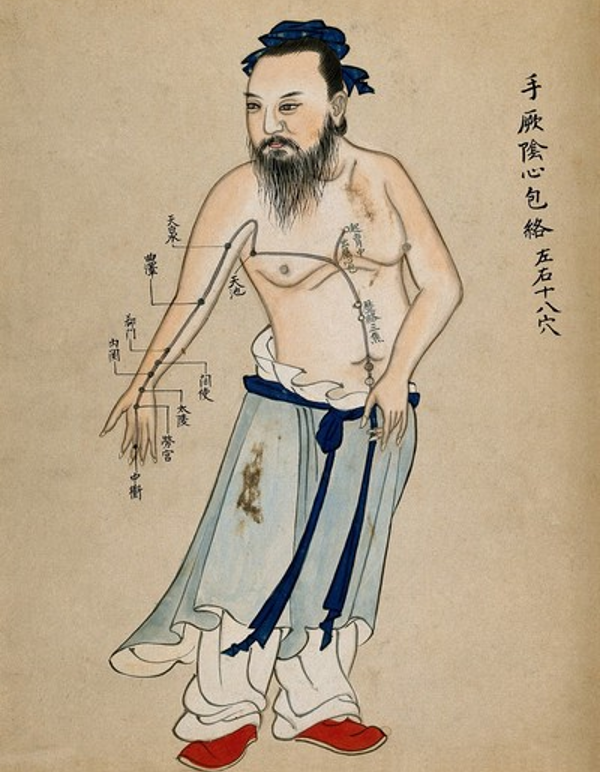
© Wellcome Collection, CC BY 4.0

What happens in the body
Stress reduction
Balance
& fall prevention
Better sleep
Vitality & natural defences
Through regular practice, Qi Gong acts deeply on the balance of the body and the nervous system: it helps ease stress, cultivate vital energy, promote more restful sleep, support mobility and strengthen the body's natural defences. A complete discipline, at the crossroads of movement, breath and presence with oneself, whose positive effects on overall wellbeing are now highlighted by several studies.
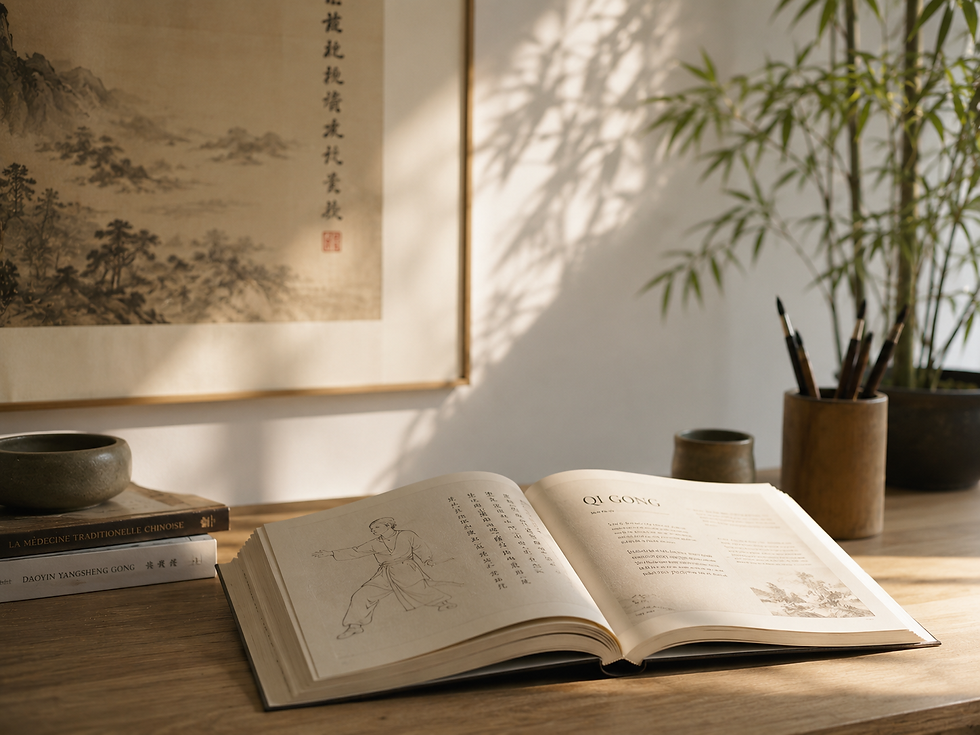
A practice shaped by more than two millennia of history
The history of Qi Gong dates back to the Han dynasty (2nd century BCE), with the Mawangdui silk scroll illustrating Daoyin, exercises based on "guiding and stretching." This tradition continued under the same dynasty with the physician Hua Tuo, who codified the Five Animal form, a codified set of movement for health benefits. The first known written document, the Yangsheng Lun by Xi Kang (223-262), then laid the theoretical foundations of life hygiene, gymnastics, and diet for the future Qi Gong. Tradition then situates two stages separated by several centuries: in the 6th century, the Yi Jin Jing, associated with Bodhidharma to strengthen the Shaolin monks; then in the 12th century, the Ba Duan Jin, associated with General Yue Fei to prepare his soldiers for combat. In the 20th century, several influential figures emerged in China, most notably Liu Guizhen, who structured modern Qi Gong around three regulations: Tiao Shen (posture), Tiao Xi (breath), and Tiao Xin (mind) — the approach that today engages most closely with Western medicine.

Accessible to all, a practice to explore and deepen throughout life.
This may be one of Qi Gong's great features: one can begin knowing nothing, with no particular physical condition, and feel something from the very first sessions. And yet this practice is a path with no final destination — every session opens a new one. It grows with whoever cultivates it, like a tree whose roots deepen as its canopy unfolds in silence, season after season. At the White Crane School, Qi Gong is taught in this spirit: accessible to all, rigorous in its transmission, rooted in tradition and open to dialogue with Western understanding of the body.

Complementary practices
Qi Gong is not taught in isolation. Two disciplines enrich and complement it at the White Crane School: heart coherence, which serves as the entry threshold for every class, and Tai Chi Chuan, which extends the work of energy into space and movement. Three distinct practices, each respected in its own form.

Testimonials
Je suis du matin. La méditation et la prière font partie du rituel matinal pour moi.
Le Qi Gong m’apporte sérénité, balance et connexion entre l’esprit, le cœur et le corps. Une courte séance le matin me rend zen pour démarrer ma journée.
Katia V.
De Qi Gong lessen van Marc zijn de perfecte manier om de dag te starten. Marc heeft een fijne, rustige en pedagogische aanpak. Ik beveel zijn lessen zeker aan!
Carolien E.
Merci beaucoup Marc pour ce bon moment de détente et de connexion à soi !
